JEPA vs LLM, and what JEPA alone doesn't give you.
LLMs predict the next word; JEPA predicts meaning. Where the two differ, and the two things PRISM adds for real decisions: self-monitoring and an audit trail.
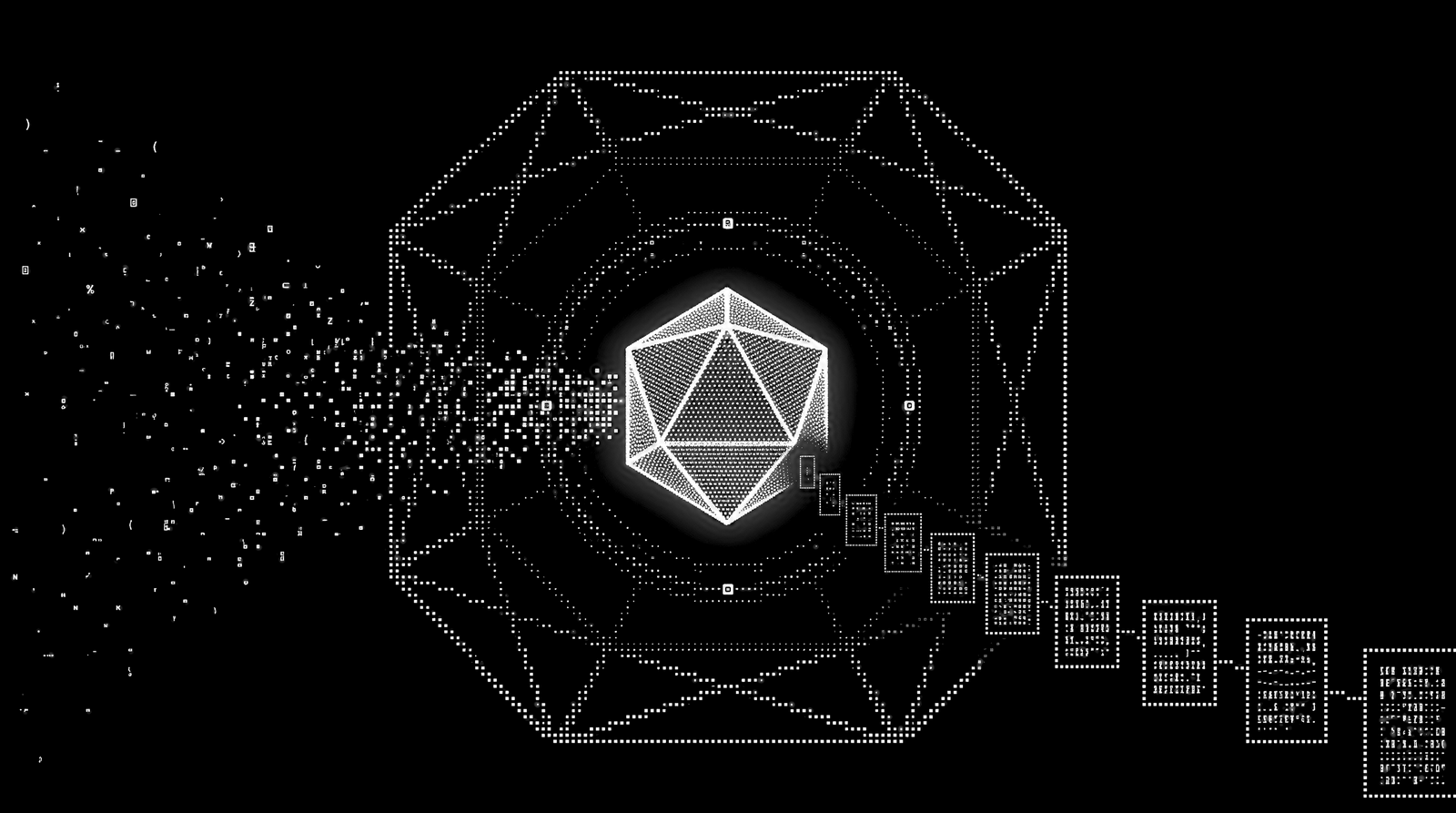
An LLM predicts the next word. JEPA, the Joint Embedding Predictive Architecture proposed by Yann LeCun, predicts meaning: it works in an internal space of concepts and scores how well things fit. PRISM builds on that family of ideas and adds what JEPA alone does not give you: a model that watches its own consistency and explains its decisions.
Predicting words.
A large language model reads text and learns to guess the next token. Everything it does, from answering questions to writing code, is that guess, repeated. It is fluent because language is what it was trained on.
Predicting meaning.
JEPA does not try to reconstruct the raw input word by word or pixel by pixel. It encodes the input into an abstract representation and predicts the representation of what is missing or what comes next. The fit between the two is measured by an energy function. I-JEPA applied this to images, V-JEPA to video.
The result is a model that learns structure, not surface. That is why JEPA is the reference architecture for the move beyond language models.
What JEPA does not do by itself.
JEPA learns to predict well. It is not, on its own, built to notice when a chain of its own reasoning contradicts itself, or to tell a person why it decided what it decided. For research, that is fine. For a credit decision, a grid command or a defense system, it is the whole question.
PRISM takes the energy-based, representation-level idea and adds two things: metacognition, where the model measures its own consistency while it reasons and corrects before it outputs, and a natural-language record of every decision.
Which one when.
Use an LLM when you need fluent text. Use JEPA-style models when you need perception and prediction. Use PRISM when the answer has to be checked before it is acted on, and you need to show how it was reached. A language model can still do the talking on top.
Short answers
Straight answers to what investors and partners ask us first.
Joint Embedding Predictive Architecture: a model that predicts the abstract representation of missing or future input, instead of the raw input itself.
No. JEPA works on representations of meaning and is not trained to predict the next word.
PRISM builds on energy-based models and JEPA-style learning in latent space, and adds self-monitoring and an audit trail. Its architecture is shared under NDA.
See it working.
We show the PRISM proof of concept live, and share the technical brief and data room with qualified investors and partners.
Nothing on this website is an offer to sell or a solicitation to buy securities.