Who invented the transformer, and why Google did not win with it.
The 2017 paper Attention Is All You Need invented scaled dot-product and multi-head attention. How OpenAI moved first, why Google fell behind, and the limit the whole field inherited.
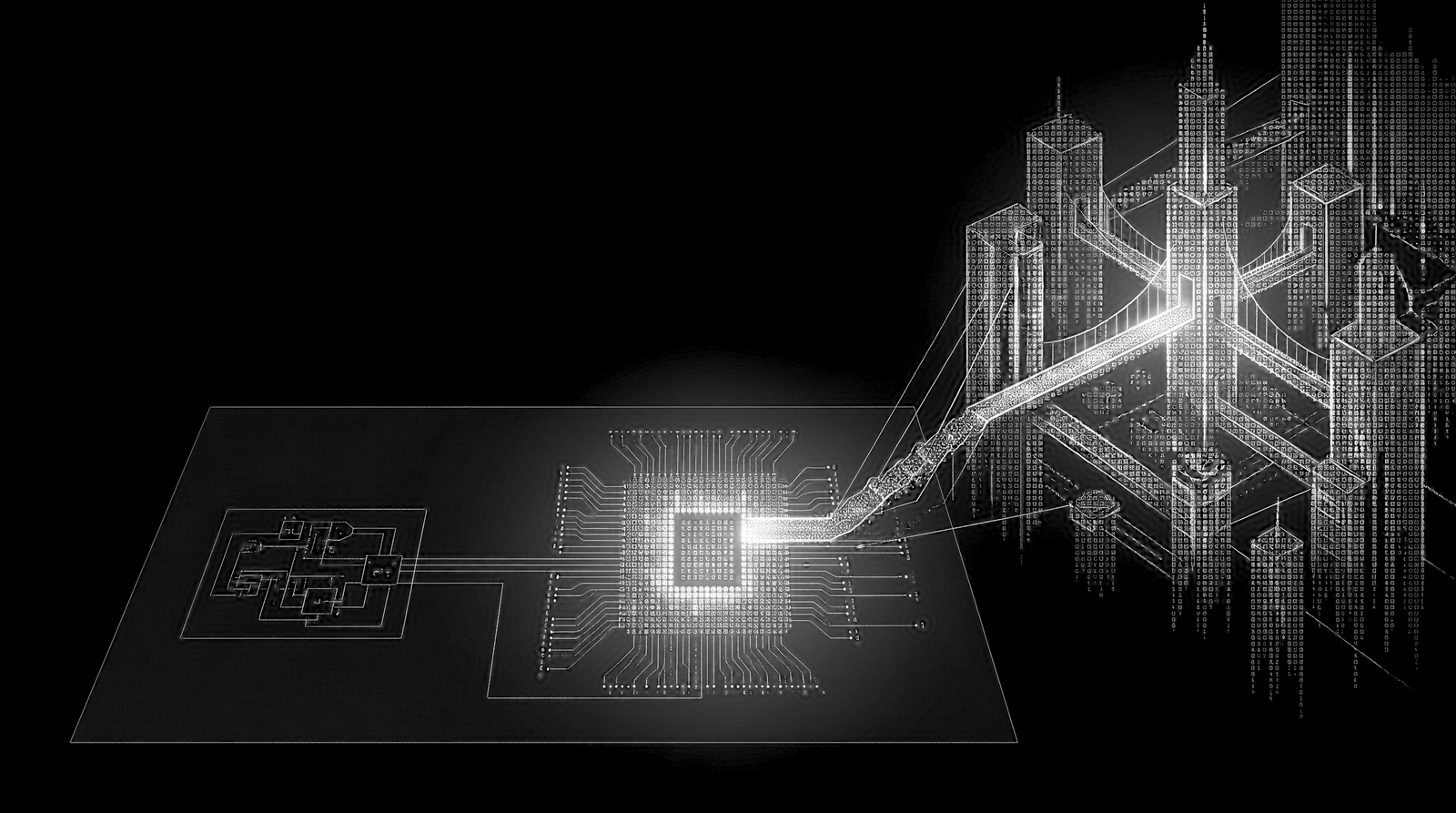
Eight researchers at Google invented the transformer in the 2017 paper Attention Is All You Need. Their inventions were scaled dot-product attention and multi-head attention, built to improve machine translation. Google did not move first with it: OpenAI published GPT-1 in June 2018, four months before Google's BERT, and the line that led to ChatGPT began there.
Translation was the bottleneck.
Before 2017, the best translation models read a sentence one word at a time, in order. That made them slow to train and weak at connecting words far apart in a long sentence.
What the paper actually introduced.
Attention itself was older: researchers had used it since 2014 to let a translation model look back at the right words of the source sentence. The 2017 paper removed the word-by-word reading entirely and built a model out of attention alone.
Two parts were new and are still inside every large language model. Scaled dot-product attention lets every word weigh every other word at once. Multi-head attention runs many of those comparisons in parallel, each free to track a different kind of relation. Because the model no longer reads in order, the position of each word is added as a pattern of sine and cosine waves.
OpenAI, four months ahead.
In June 2018 OpenAI published GPT-1, a transformer trained to predict the next word on large amounts of text. Google's BERT followed in October 2018. OpenAI kept scaling the same idea through GPT-2 and GPT-3, and released ChatGPT in November 2022. Google announced Bard in February 2023, as the answer to a market OpenAI had already taken.
All eight authors of the paper left Google. One of them, Noam Shazeer, came back in 2024 to co-lead Gemini, and left again for OpenAI in June 2026.
One architecture took the money, the chips and the talent.
In 2019 Rich Sutton, who later won the Turing Award, published The Bitter Lesson: across 70 years of AI, general methods that make the most of computing power have beaten methods built around human cleverness. The transformer became the strongest case for it. It scales almost perfectly on GPUs, so it spread from text to images, audio, biology and robotics, and the industry put its money, chips and researchers into making the same design bigger.
That concentration is now criticized from inside. At TED AI in October 2025, Llion Jones, one of the eight authors of the 2017 paper, warned that the race built on that paper is stifling the next breakthrough, and has moved his own research away from transformers. Sutton himself argued in 2025 that large language models are a dead end, because they learn from human text instead of from experience, and so do not follow his lesson as well as people assume.
Faster transformers are still transformers.
The best-known alternatives, such as Mamba and RWKV, make a model read long text faster and with less memory. They still do the same job: predict the next word.
The limit is in that job itself. Predicting the next word from probabilities is extraordinary for language and was never built to check logic. Why LLMs cannot reason.
A different starting point.
PRISM does not start from predicting text. It starts from a principle of physics: systems settle into the state that takes the least energy. An answer that fits what the model knows has low energy, and a contradiction makes the energy rise, so PRISM corrects itself before it speaks. Our story.
- Vaswani et al., Attention Is All You Need (2017)
- Bahdanau et al., Neural Machine Translation by Jointly Learning to Align and Translate (2014)
- Radford et al., Improving Language Understanding by Generative Pre-Training (OpenAI, June 2018)
- Devlin et al., BERT (Google, October 2018)
- Google: An important next step on our AI journey (Bard, Feb 2023)
- R. Sutton, The Bitter Lesson (2019)
- TED AI: Llion Jones, How competition is stifling AI breakthroughs (Oct 2025)
- Dwarkesh Podcast: Richard Sutton thinks LLMs are a dead end (Sep 2025)
- Gu & Dao, Mamba (2023)
- Peng et al., RWKV (2023)
- 9to5Google: Gemini's co-lead is leaving Google to join OpenAI (Jun 2026)
Short answers
Straight answers to what investors and partners ask us first.
Eight researchers at Google, in the 2017 paper Attention Is All You Need: Ashish Vaswani, Noam Shazeer, Niki Parmar, Jakob Uszkoreit, Llion Jones, Aidan Gomez, Lukasz Kaiser and Illia Polosukhin.
No. Attention was introduced for translation in 2014. The 2017 paper invented scaled dot-product attention and multi-head attention, and the transformer built only from attention.
Generative Pre-trained Transformer: a transformer trained in advance on large amounts of text to predict the next word.
Yes. Models like Mamba and RWKV are faster at long text but still predict the next word. Energy-based models like PRISM work differently: they score whether an answer fits before producing it.
See it working.
We show the PRISM proof of concept live, and share the technical brief and data room with qualified investors and partners.
Nothing on this website is an offer to sell or a solicitation to buy securities.